Thursday, May 11, 2017

Thursday, May 4, 2017
Intel AMT Vulnerability Detection with Nessus and PVS (INTEL-SA_00075)

Intel recently announced an escalation of privilege vulnerability in the Intel® Active Management Technology (AMT), Intel® Standard Manageability (ISM), and Intel® Small Business Technology firmware, versions 6 through 11.6. This vulnerability has the potential of being a proverbial big one. The vulnerability has been part of the Intel chipsets for years, specifically the Management Engine (ME). The ME runs things like DRM (Digital Rights Management) and does TPM (Trusted Platform Modules) checks as well as AMT. AMT enables systems administrators to re-image bare metal machines over a remote connection. To accomplish that, the AMT requires many privileges, from network access to writing to memory and disk. The AMT is hardware and operates separately from any operating system installed on a system. Obviously, with this much power there is some protection: in this case, access to AMT is protected by a password. The vulnerability in AMT is that the password can be bypassed.
About AMT
The vulnerability is not in all Intel chipsets, but it does heavily impact servers (not consumer PCs). If you have explicitly enabled AMT at any point, you are at risk.
There have been very few technical details published on the vulnerability itself, other than it allows unauthenticated access to AMT. Currently, it is not known whether this vulnerability impacts all AMT installations or just those in Small Business Mode or Enterprise Mode. If it is Enterprise Mode only, then the impact to regular end users will be minimal. Enterprise Mode can be challenging to set up, and few if any home or even small business users would bother. However, if this vulnerability impacts all installations of AMT or even Small Business Mode, things will be much much worse.
AMT listens to TCP ports 16992 and 16993 to accept incoming network connections. There are already reports of people (from researchers to attackers) mass scanning the entire Internet looking for systems with these ports open.
Detection methods
Nessus
Tenable provides several detection tools to identify vulnerable servers. The credentialed Nessus® plugin #97997 detects systems that are affected by the Intel vulnerability and provides remediation guidance:
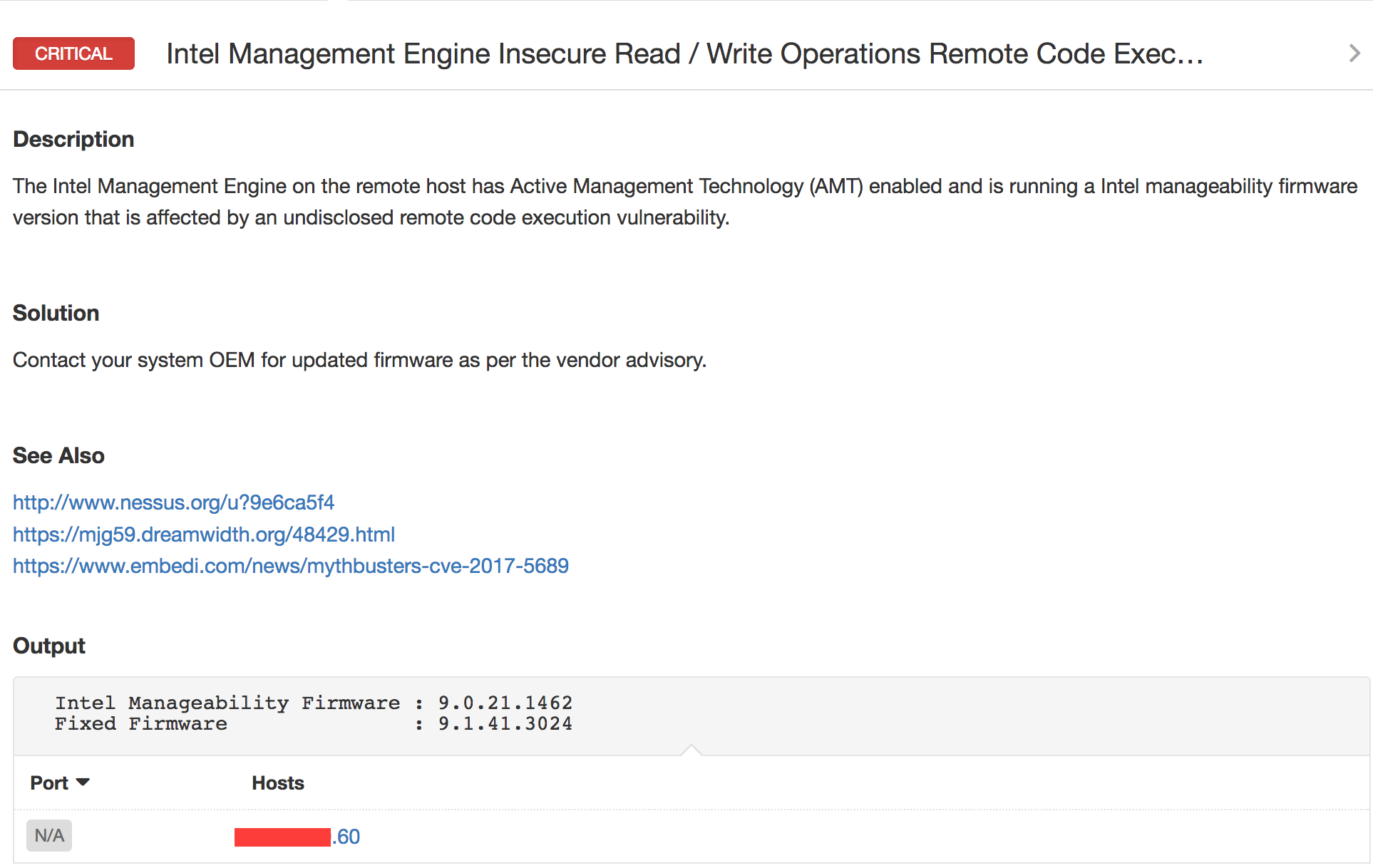
Another Nessus plugin #97998 detects vulnerable versions based on the banner of the service listening on port 16992. Note though the banner versions are not always granular enough, so in some cases it could result in false negatives. But it will accurately identify all systems that are vulnerable, so the risk of false positives is very low.
We are also investigating remote uncredentialed plugins to detect this vulnerability, and will update this blog as soon as we have more details.
PVS
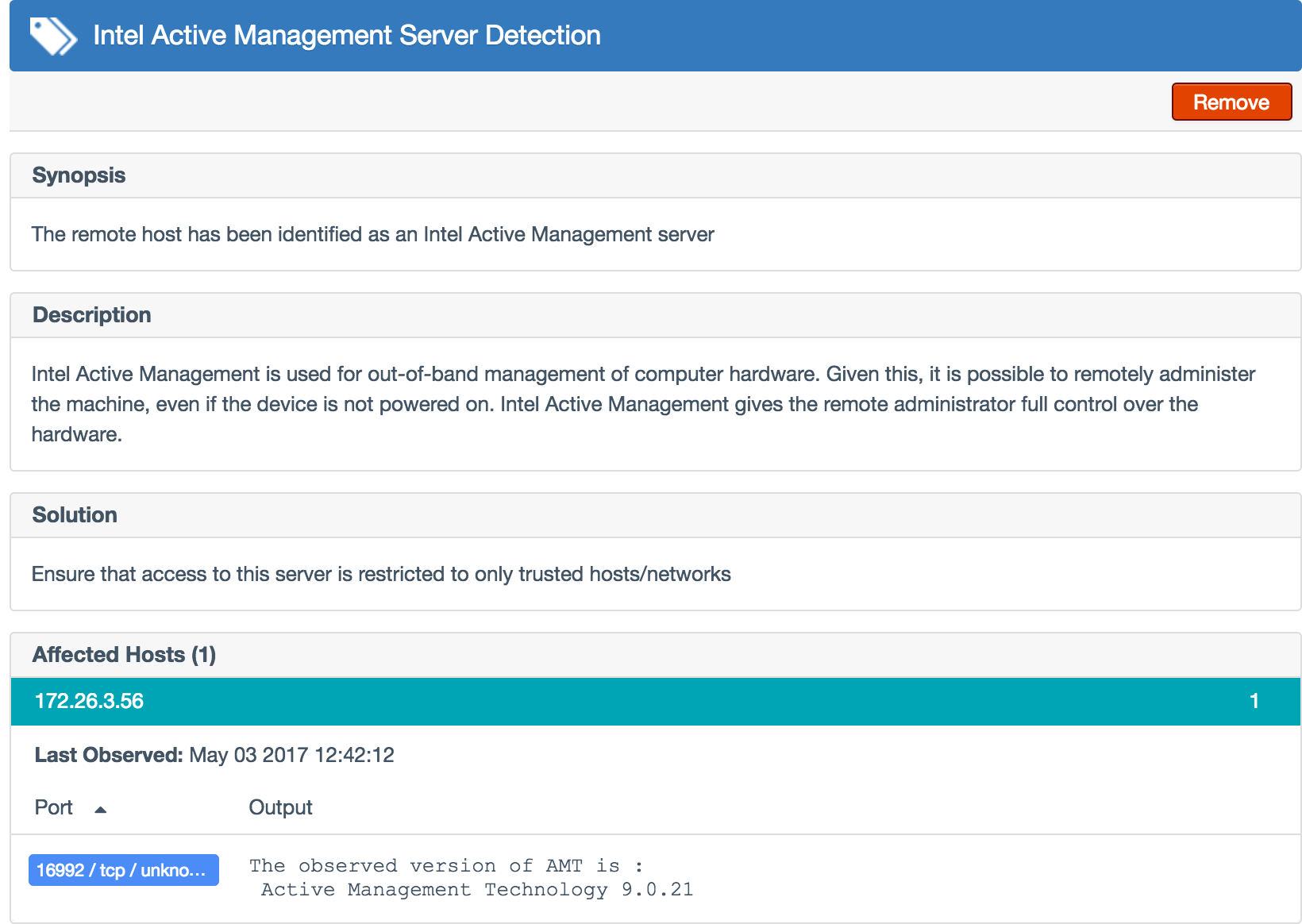
The Tenable Passive Vulnerability Scanner® (PVS™) can also detect hosts that have AMT running via plugin #6955:
SecurityCenter
SecurityCenter® users can start assessing the risk that this vulnerability presents without having to rescan the network. SecurityCenter collects many other plugins filled with service detections, banner detection, and installed software programs. The new INTEL-SA-00075 Detection dashboard uses all these options and previously collected data to identify potentially vulnerable systems, and then uses the CVE to identify systems that are confirmed vulnerable.
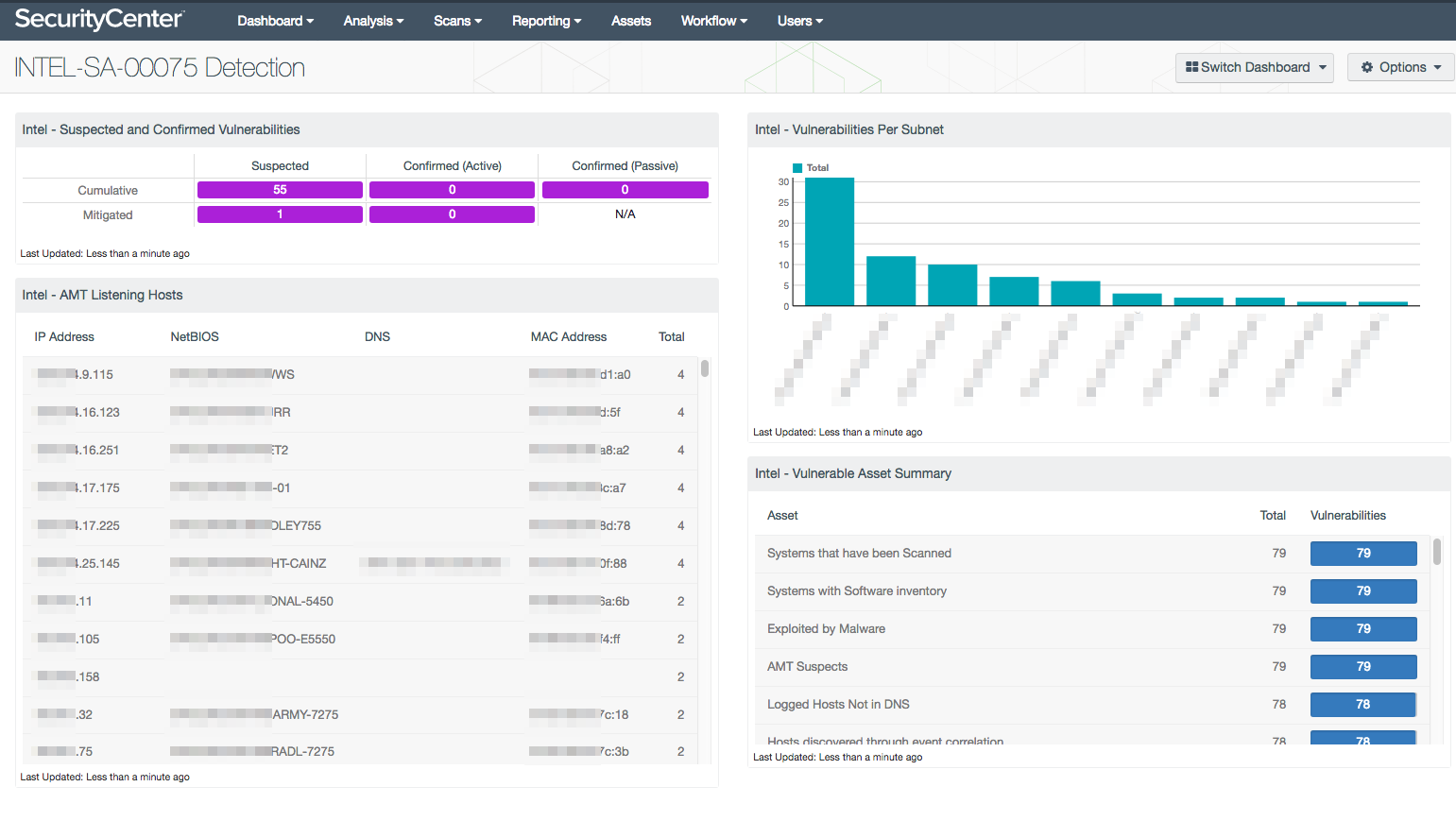
The matrix in the upper left of the dashboard identifies both current and remediated vulnerabilities. As you scan your network, find the vulnerabilities, and apply patches, the numbers will move from the Cumulative row into the Mitigated row. The dashboard also shows you if the vulnerabilities are only Suspected or if they are Confirmed, using active and passive detection methods.
The INTEL-SA-00075 Detection dashboard quickly helps you understand where the most immediate risk is in your environment.
Manual
To check if you have the supported CPU, chipset, network hardware and AMT you can either use the Tenable.io plugins described above or check your BIOS. (For most systems, use CTRL-P during boot.) If you see AMT listed there, you should disable it. Determine if you have an Intel AMT, Intel SBA, or Intel ISM capable system by reviewing this document.
Mitigation
AMT has been around for about the last seven years and most machines made with AMT since then could be at risk. Once you have identified the servers that are impacted by the Intel vulnerability, you should check with your vendor(s) for a patch release – firmware updates are not automatic and are specific to each manufacturer. Older systems obviously stopped receiving firmware updates years ago and most likely won't receive a patch for this vulnerability. If your vendor does not issue a patch, you may want to follow mitigation steps recommended by Intel.
We recommend you follow these steps immediately to secure your infrastructure; otherwise, this vulnerability could result in a remotely controlled exploit and serious consequences.

from Intel AMT Vulnerability Detection with Nessus and PVS (INTEL-SA_00075)
Monday, April 17, 2017
What the Latest Shadow Brokers Dump Means for Your Business

Last week the hacker group known as Shadow Brokers published on the internet a large cache of weaponized software exploits and hacking tools targeting numerous vendor products. This fifth release appears to be the largest and most damaging to date, featuring several previously unknown exploits in widely used enterprise IT products and details on alleged U.S. capabilities to access and monitor SWIFT banking transactions. The sheer size of this leak made this weekend a challenging one for CISOs all over the world as they rushed to make sure that they weren’t vulnerable to these new exploits before attackers started using them.
The good news is that there appears to be a patch available for just about everything in the package. In some cases — such as the exploits for Windows XP and Windows Server 2003 — there will never be any patch since support for those products has long since been discontinued. Any CISOs who still have these older systems on their networks are now vulnerable to attack and will be defenseless targets to anyone who is able to get a foothold on those networks.
Many of the patches for the exploits provided by the Shadow Brokers have only just recently been released, meaning that many organizations may have not had time to run those patches through their patch management processes and get them applied to their critical systems. Of course, just because a patch is available doesn’t automatically mean your organization is safe. The pervasiveness and severity of some of the vulnerabilities in this drop makes it critical that you’re able to properly prioritize and patch every affected system in your environment.
In some cases, those patches may never be applied, whether due to a conscious decision to preserve the operational status of a crucial system, or possibly due to imperfect knowledge about what’s on the network and the impact of these blind spots on overall security. A look at historical patch MS08-67 is an excellent example. This critical vulnerability from 2008 is one that lived for years within organizations. This is the first thing that penetration testers would look for when compromising a network. MS08-67 has now been replaced by MS17-10. While there is a patch available, there will always be one machine that someone overlooked that a penetration tester or an attacker will find and use to compromise your network.
This is why conducting a proper system inventory is of such high importance to any commercial organization or government agency. You can’t protect what you don’t know. You can’t patch it either.
The Tenable research team spent the weekend reviewing the files released by the Shadow Brokers. Here are the highlights:
- Microsoft patched vulnerabilities in all supported versions of Microsoft software.
- Unsupported software such as IIS 5/6, Windows XP, Windows 2000/XP/Vista/2003, Exchange 2007 are vulnerable and should be upgraded to supported versions.
- Disable SMBv1. Microsoft and CERT have long recommended disabling SMBv1 where possible.
- A toolkit is already being leveraged to push Cobalt Strike, Metasploit, PoisonIvy, Empire and other payloads that are available as DLLs using DLL injection.
Tenable coverage and solutions
We have developed a SecurityCenter® dashboard tailored to identify hosts that may be susceptible to the vulnerabilities and exploits published by the Shadow Brokers hacking group. The Shadow Broker Vulnerability Detection dashboard is available through the SecurityCenter Feed to provide insight into the vulnerability of your network and the progress made toward upgrading outdated hosts.

The Tenable Research Team has many plugins already available to address these vulnerabilities. We are also actively developing new plugins specific to this package. Here are the relevant solutions; we will continue to update this post as more plugins become available.
| Exploit | Plugin Title/Comments | Plugin ID |
|---|---|---|
|
EternalBlue EternalChampion EternalSynergy EternalRomance |
MS17-010: Security Update for Microsoft Windows SMB Server (4013389) |
|
|
EmeraldThread |
MS10-061: Vulnerability in Print Spooler Service Could Allow Remote Code Execution (2347290) |
|
|
EsikmoRoll |
MS14-068: Vulnerability in Kerberos Could Allow Elevation of Privilege (3011780) |
|
|
EducatedScholar |
MS09-050: Microsoft Windows SMB2 _Smb2ValidateProviderCallback() Vulnerability (975497) MS09-050: Vulnerabilities in SMBv2 Could Allow Remote Code Execution (975517) |
|
|
EclipsedWing |
||
|
EsteemAudit |
Microsoft Windows XP Unsupported Installation Detection Microsoft Windows Server 2003 Unsupported Installation Detection |
|
|
ExplodingCan |
Microsoft IIS 6.0 Unsupported Version Detection |
97993 |
|
EMPHASISMINE |
Lotus Domino Unsupported Product |
97994 |
|
EnglishmanDentist |
Microsoft Exchange Server Unsupported Version Detection |
22313 |
Many thanks to the Tenable research team for their contributions to this blog.

from What the Latest Shadow Brokers Dump Means for Your Business